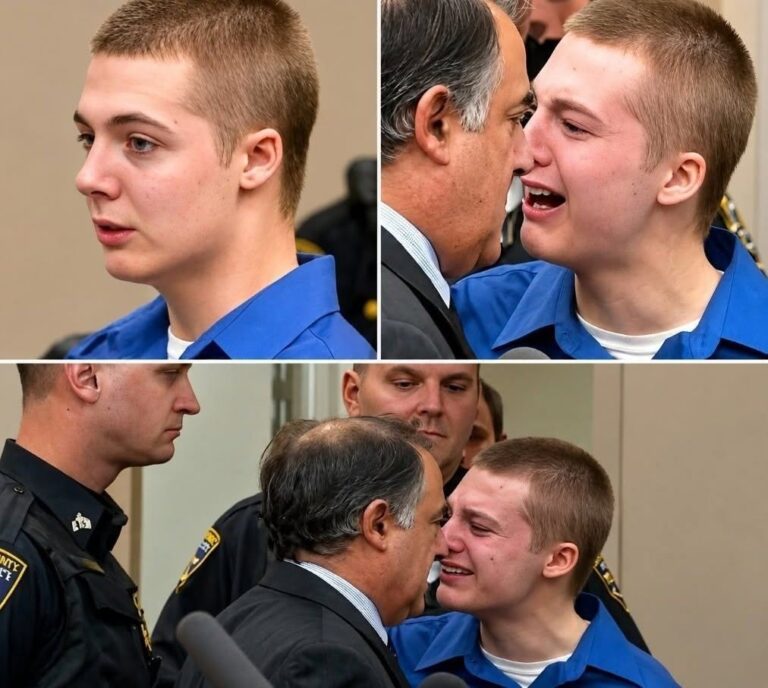
Testimonies of the Fractured
When the courtroom doors swung open, the smell of stale coffee mingled with the metallic chill of the air conditioner.
“I still hear his footsteps on the porch at night,” Mrs. Delgado whispered, clutching a faded photograph of her son. The tremor in her voice cut through the silence.
She stared at the empty seat where her boy had sat just hours before, the same seat now occupied by the prosecutor’s stack of evidence.
“He broke my window,” Mr. Kwan said, his hands shaking as he tried to steady a photograph of the shattered glass. “He looked at me like I was nothing.”
In the back, Alex’s mother pressed her forehead to the cool wood, tears forming a river of disbelief.
“He was our boy. How could this be?”
The prosecutor rose, his voice a razor. “Ladies and gentlemen, the journal found in his room details each step—the timing, the targets, the motives. He wrote, ‘They will learn to fear.’ This was not a moment of madness; it was a plan.”
He turned a page, a handwritten entry glaring under the courtroom light: “Tonight, I’ll make them regret every insult.”
“He knew exactly what he was doing,” the prosecutor continued, “and he wanted us to feel the terror he created.”
Audience members shifted, some covering their ears as if the words could still echo into the present.
Alex’s sister, Emma, sat rigid, her eyes fixed on the floor, the weight of the courtroom pressing down on her shoulders.
Defense’s Plea for Mercy
When the defense rose, a soft murmur rippled through the room, as if hope tried to find a foothold.
“Your Honor, my client is not a monster,” the attorney said, voice steady but tinged with urgency. “He is a boy shaped by a broken home, a mother who worked double shifts, a father absent for years.”
He slid a file across the bench, the pages filled with school reports, disciplinary notes, and a bruised photograph of a younger Alex. “He was bullied, he was ignored,” the lawyer whispered, eyes flashing to the jurors.
“He is capable of change,” he argued, “if given the chance to heal, to learn, to make amends.”
Alex’s defense attorney paused, letting the silence settle like dust. He could see the judge’s eyes hardening, the gavel waiting.
“Your Honor, the sentence you propose will erase any possibility of redemption,” the attorney pleaded, “and will set a precedent that our youth is beyond salvation.”
The judge’s gaze was a wall of granite. “I have heard enough,” he said, voice flat. “The crimes are unforgivable, the public cannot be left vulnerable.”
He turned his attention to the journal, now a symbol of calculated cruelty. “Premeditation is evident,” the judge declared, “and the community’s safety must prevail.”
Just as the gavel was about to fall, Emma stood, her voice trembling. “I tried to tell them,” she said, “I sent messages, I called… but I… I deleted them because I was scared.”
The courtroom fell into a stunned hush. The judge’s eyebrows knit, his expression skeptical. Evidence showed no record of those messages.
